A concrete driveway is one of the most consequential investments a homeowner makes — not because it’s flashy, but because a poorly built one costs far more to fix than it ever would have cost to do right the first time. Thickness is a critical variable, but it’s only one piece of a larger structural system.
Thickness by use case
Use this table as a starting point; your contractor should confirm based on local soil conditions and load expectations.
| Driveway Use | Thickness | Reinforcement |
|---|---|---|
| Standard residential vehicles | 4 in. | Fiber mesh or rebar |
| Heavy SUVs & pickup trucks | 5 in. | Rebar recommended |
| RV parking areas | 6 in. | Rebar grid |
| Commercial vehicles | 6–8 in. | Engineered reinforcement |
| Garage aprons | 5–6 in. | Rebar recommended |
Why Driveway Thickness Matters More Than Most Homeowners Realize
A concrete driveway is more than a finished surface. It is a structural system designed to distribute thousands of pounds of weight across the ground beneath it.
When homeowners notice cracking, sinking, or uneven sections, they often assume the concrete itself failed. In reality, the problem frequently began long before the concrete was poured.
A driveway must withstand all of the following simultaneously:
- Daily vehicle traffic and repetitive load cycles
- Freeze-thaw cycles that expand and contract the slab
- Ground movement caused by seasonal soil changes
- Heavy rain events that saturate and destabilize the subgrade
- Deicing chemicals that infiltrate surface pores
- Soil expansion and contraction from moisture variation
In St. Louis, where summers are hot and humid and winters regularly dip below freezing, concrete experiences significant cumulative stress throughout the year. The proper thickness helps the slab resist bending, flexing, and cracking under those changing conditions.
A Common Misconception: Thicker Is Always Better
Many homeowners assume that pouring a thicker slab automatically produces a superior driveway. The truth is more nuanced.
A poorly prepared 6-inch driveway can fail faster than a properly installed 4-inch driveway. Concrete performs best when the entire system works together:
- Proper excavation to the correct depth
- Compacted subgrade that provides a stable platform
- Crushed stone aggregate base for drainage and load distribution
- Reinforcement positioned correctly within the slab
- Quality concrete mix designed for the application
- Proper finishing technique and control joint placement
- Correct curing process to develop full strength
Each layer supports the one above it. Think of it like the structural integrity of a quality home: no matter how beautiful the finishes are, they won’t perform well if the foundation underneath them is unstable.
The St. Louis Factor: Why Local Conditions Matter
Not every driveway recommendation found online applies equally to Missouri homeowners. The greater St. Louis area presents several unique challenges that directly influence how a driveway should be engineered.
Expansive Clay Soils
Many neighborhoods throughout St. Charles County, St. Louis County, and surrounding communities contain clay-rich soils. Clay expands when wet and contracts when dry. Over time, this cyclical movement creates stress beneath a concrete slab that even a correctly specified thickness cannot fully compensate for on its own. The aggregate base becomes especially critical in these areas.
Freeze-Thaw Cycles
Water enters microscopic pores in concrete. When temperatures drop below freezing, that water expands with tremendous force. Repeated freeze-thaw cycles place pressure on the slab from within and can accelerate surface deterioration and internal cracking if the driveway was not properly installed or sealed.
Heavy Rainfall Events
Missouri experiences significant seasonal rainfall. Poor drainage allows water to accumulate beneath concrete, weakening support and contributing to settlement and heaving over time.
In St. Louis, a driveway’s longevity often depends less on the concrete you can see and more on the preparation you cannot. The aggregate base and subgrade compaction are invisible after installation — but they determine how the surface performs for decades.

Is Four Inches Really Enough?
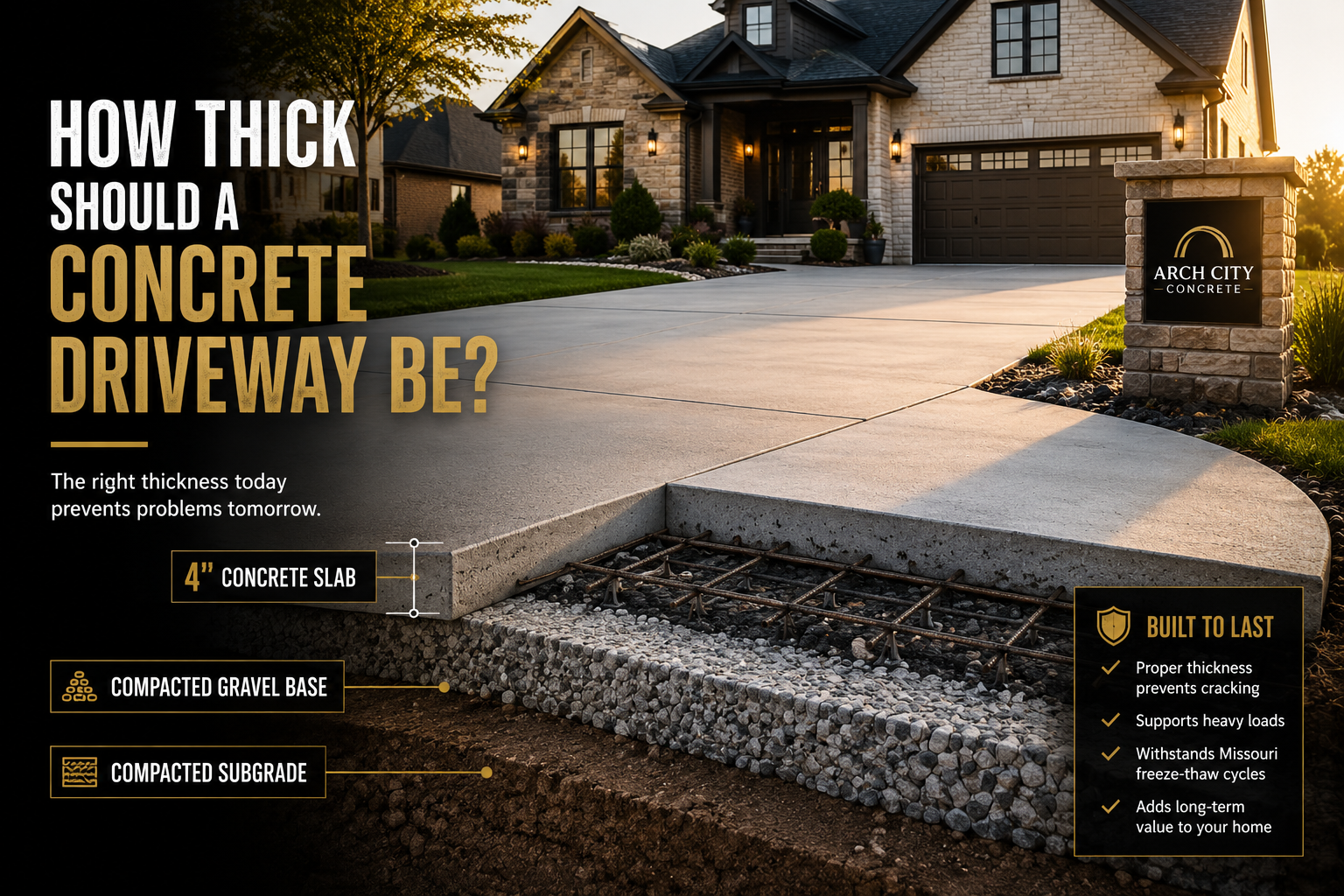
For the vast majority of residential homes, yes. A properly installed 4-inch concrete driveway has been the industry standard for decades because it provides an effective balance of structural strength, durability, cost efficiency, and long-term performance.
Most passenger vehicles weigh between 3,000 and 6,000 pounds. A properly reinforced 4-inch slab distributes that weight effectively across a compacted base. For families with standard sedans, minivans, and crossovers, increasing thickness beyond 4 inches may offer limited practical benefit relative to the additional cost.
When Should You Consider a 5-Inch Driveway?
Certain situations justify additional thickness. You may benefit from a 5-inch driveway if any of the following apply:
- You regularly park full-size pickup trucks or large SUVs
- You have multiple heavy vehicles sharing the same surface
- You expect frequent delivery or service vehicle traffic
- Your soil conditions are particularly expansive or unstable
- You want added long-term durability as a proactive investment
The cost increase from 4 to 5 inches is often modest relative to the overall project budget, while the additional structural capacity can provide meaningful peace of mind over decades of use. Many homeowners view this as a prudent upgrade when investing in a new driveway.
When Six Inches Makes Sense
A 6-inch slab is generally reserved for situations involving substantially heavier loads or concentrated point stresses. Common applications include:
- RV storage and parking areas
- Boat parking pads and trailer storage
- Work trucks and heavy equipment access areas
- Commercial or semi-commercial vehicle traffic
- Equipment trailers and loaded flatbeds
These vehicles place concentrated pressure on relatively small contact areas, increasing stress on the concrete surface. A thicker slab with appropriate reinforcement helps distribute those loads more effectively across the subgrade.
The Most Important Layer Is Often Hidden
One of the most frequently overlooked components of any driveway is the aggregate base. Before concrete is poured, contractors install a compacted layer of crushed stone or gravel beneath the slab. This layer serves several critical functions simultaneously:
- Drainage: Water moves through gravel more effectively than compacted soil, reducing hydrostatic pressure beneath the slab
- Load distribution: The aggregate base helps spread vehicle weight over a larger area of the subgrade
- Settlement resistance: Compacted stone provides a stable platform that minimizes future movement
- Freeze-thaw protection: A properly drained base reduces trapped moisture beneath the concrete
For many St. Louis homes, a 4- to 6-inch aggregate base is just as important as the thickness of the concrete itself. A driveway should be engineered from the ground up — not simply poured on top of whatever soil happens to be there.
Rebar, Wire Mesh, and Fiber Reinforcement
Homeowners frequently ask whether reinforcement is necessary and which type is best. The answer depends on the application, but reinforcement almost always improves long-term performance.
Rebar
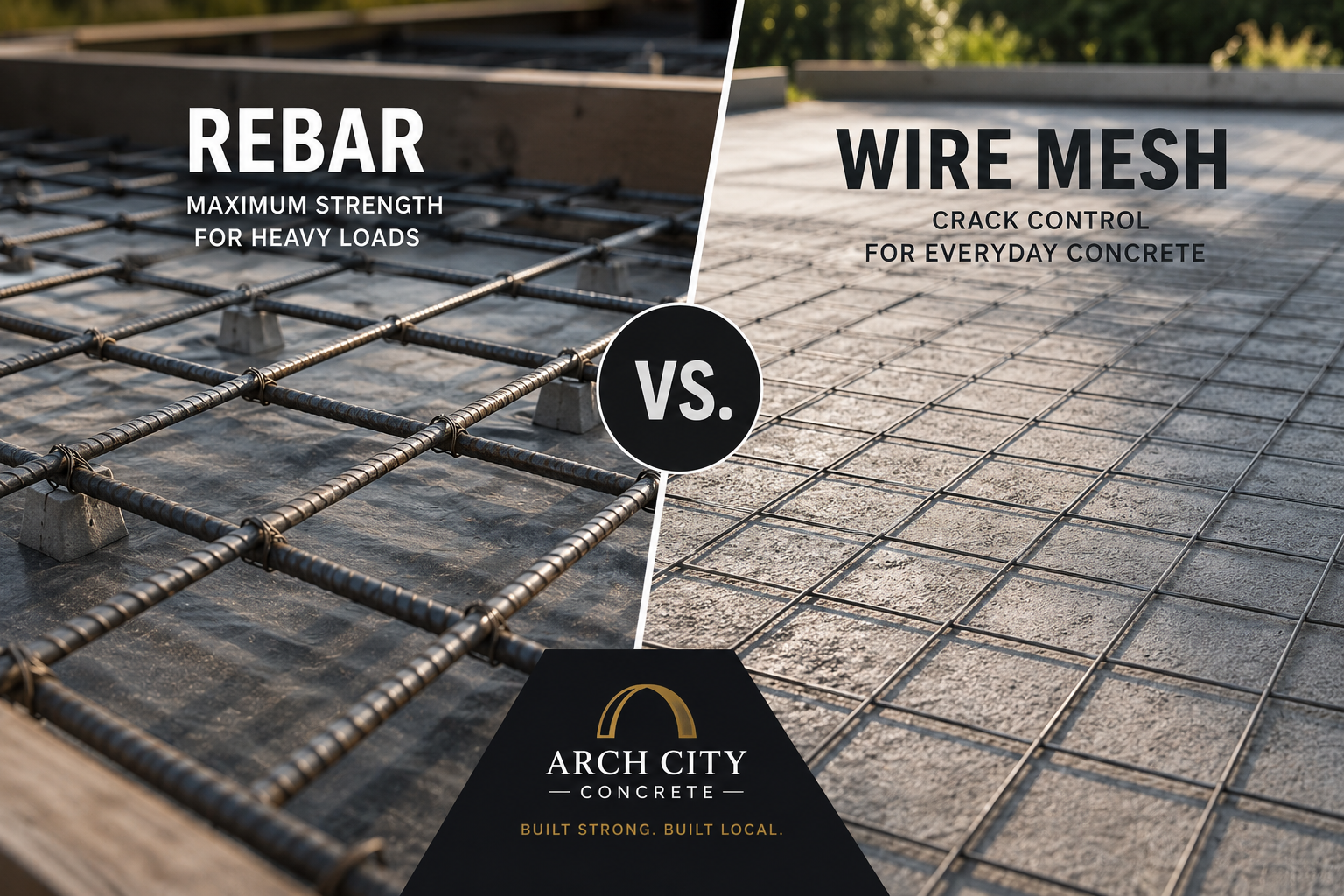
Steel reinforcing bars placed within the slab before the pour. Rebar provides the greatest structural strength, best crack control, and superior load distribution. Many contractors recommend rebar for driveways expected to support heavier vehicles. For a deeper comparison, see our guide on rebar vs. wire mesh for concrete.
Wire Mesh
A welded grid of steel wires provides crack resistance but generally offers less structural benefit than properly placed rebar. Its effectiveness also depends heavily on being correctly positioned within the slab during installation.
Fiber Reinforcement
Synthetic fibers mixed directly into the concrete batch. Fiber reinforcement reduces shrinkage cracking and improves surface durability. Many modern installations combine fiber reinforcement with rebar for comprehensive structural coverage.
Understanding Control Joints
Concrete cracks. That statement surprises many homeowners, but it is a fundamental property of the material. The goal of good concrete work is not to eliminate cracking entirely — it is to control where cracking occurs.
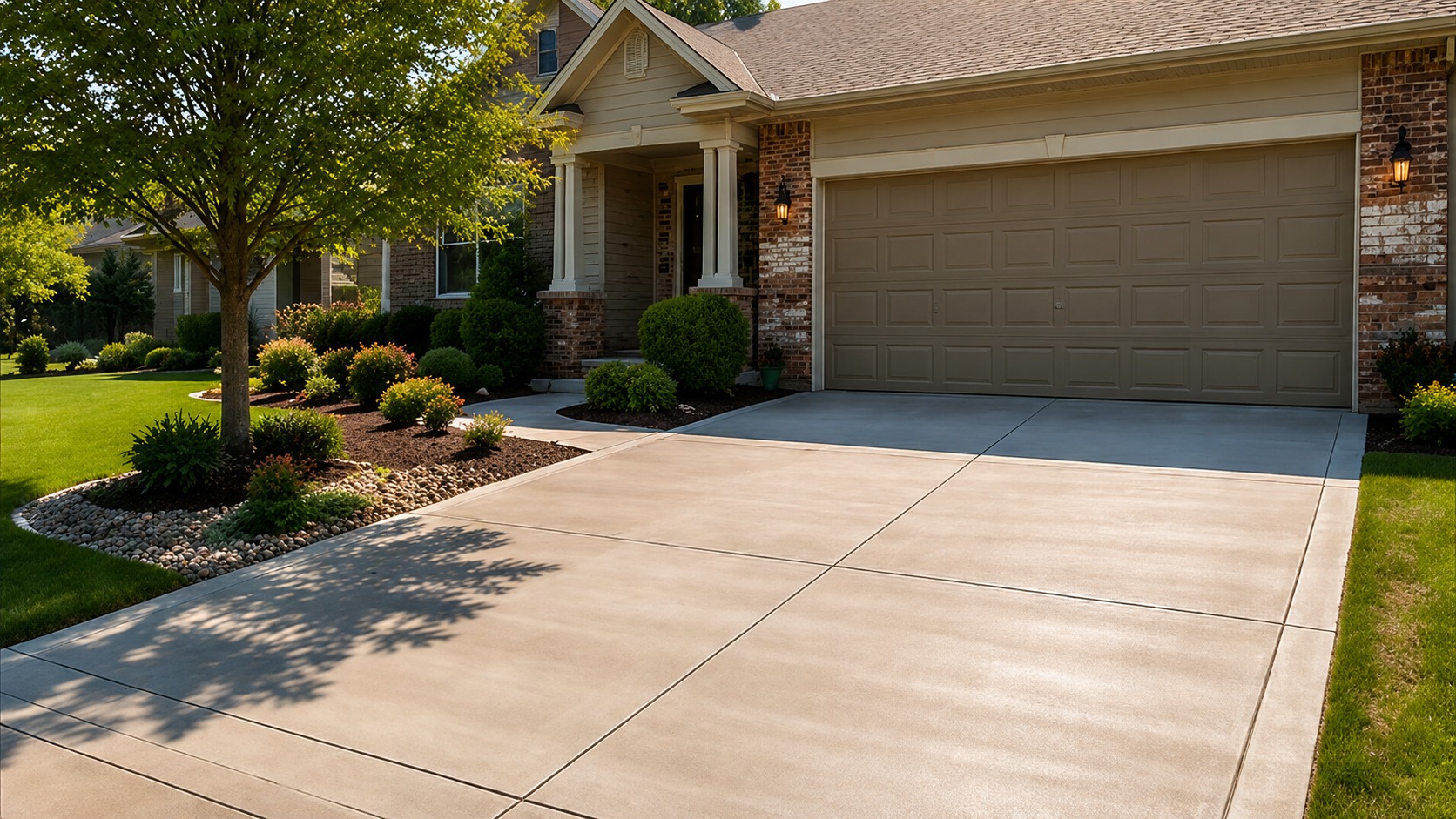
Control joints are intentionally placed grooves that encourage concrete to crack in predictable, planned locations rather than across visible sections of the driveway. A properly jointed driveway appears clean and organized while minimizing random surface cracking. Without adequate joints, concrete often develops unsightly cracks in the most visible areas.
A driveway should be engineered from the ground up — not simply poured on top of whatever soil happens to be there. The system is what performs; the thickness is just one variable within it.
Signs Your Existing Driveway May Be Too Thin
If you’re evaluating an older driveway, certain symptoms can indicate insufficient thickness or inadequate base preparation. Watch for any of the following:
- Multiple structural cracks running across the slab
- Surface settlement or sections sitting lower than adjacent areas
- Edge deterioration or crumbling along the perimeter
- Depressions in vehicle wheel-path areas
- Sections that rock or flex under vehicle weight
- Repeated patch repairs that don’t hold
While some cosmetic cracking is normal over time, widespread structural failure typically points to underlying construction deficiencies that surface repairs cannot permanently resolve.
How Long Should a Concrete Driveway Last?
A professionally installed concrete driveway should commonly last between 25 and 40 years or more, depending on the quality of installation, drainage conditions, reinforcement, and ongoing maintenance. Driveways that fail significantly sooner are often associated with poor subgrade preparation, inadequate drainage, improper concrete placement, insufficient thickness, or lack of reinforcement. Longevity is rarely determined by a single factor — the best-performing driveways result from attention to every stage of construction.
The Cost of Doing It Right
Homeowners sometimes focus heavily on obtaining the lowest bid. While budget always matters, the least expensive proposal is not always the best value.
A contractor who properly excavates the site, installs a quality aggregate base, uses the correct concrete mix, places reinforcement accurately, establishes proper drainage, and cures the slab appropriately may charge more initially. However, replacing a failed driveway is substantially more expensive than building one correctly the first time.
The most expensive concrete driveway is the one you have to replace twice. Investing in correct thickness, proper base preparation, and appropriate reinforcement upfront is almost always cheaper than premature replacement.
Final Recommendation for St. Louis Homeowners
If you’re planning a new driveway in St. Louis, St. Charles County, O’Fallon, St. Peters, Wentzville, Chesterfield, or surrounding communities, a properly installed 4-inch reinforced concrete driveway over a compacted aggregate base remains the industry standard for most residential applications.
Homeowners with heavier vehicles may benefit from upgrading to 5 inches, while RV parking and commercial applications often justify 6 inches or more. Most importantly, remember that thickness is only one piece of the puzzle. A durable driveway depends on proper excavation, drainage, reinforcement, concrete quality, and workmanship. When all of those elements work together, your driveway becomes a long-term investment in your home’s appearance, functionality, and value.
- How thick will the concrete be?
- What type of base will be installed, and how deep?
- What reinforcement will be used and how will it be positioned?
- How will drainage be addressed?
- What curing process will be followed?
The answers to those questions will tell you far more about the quality of the finished product than the price alone.