
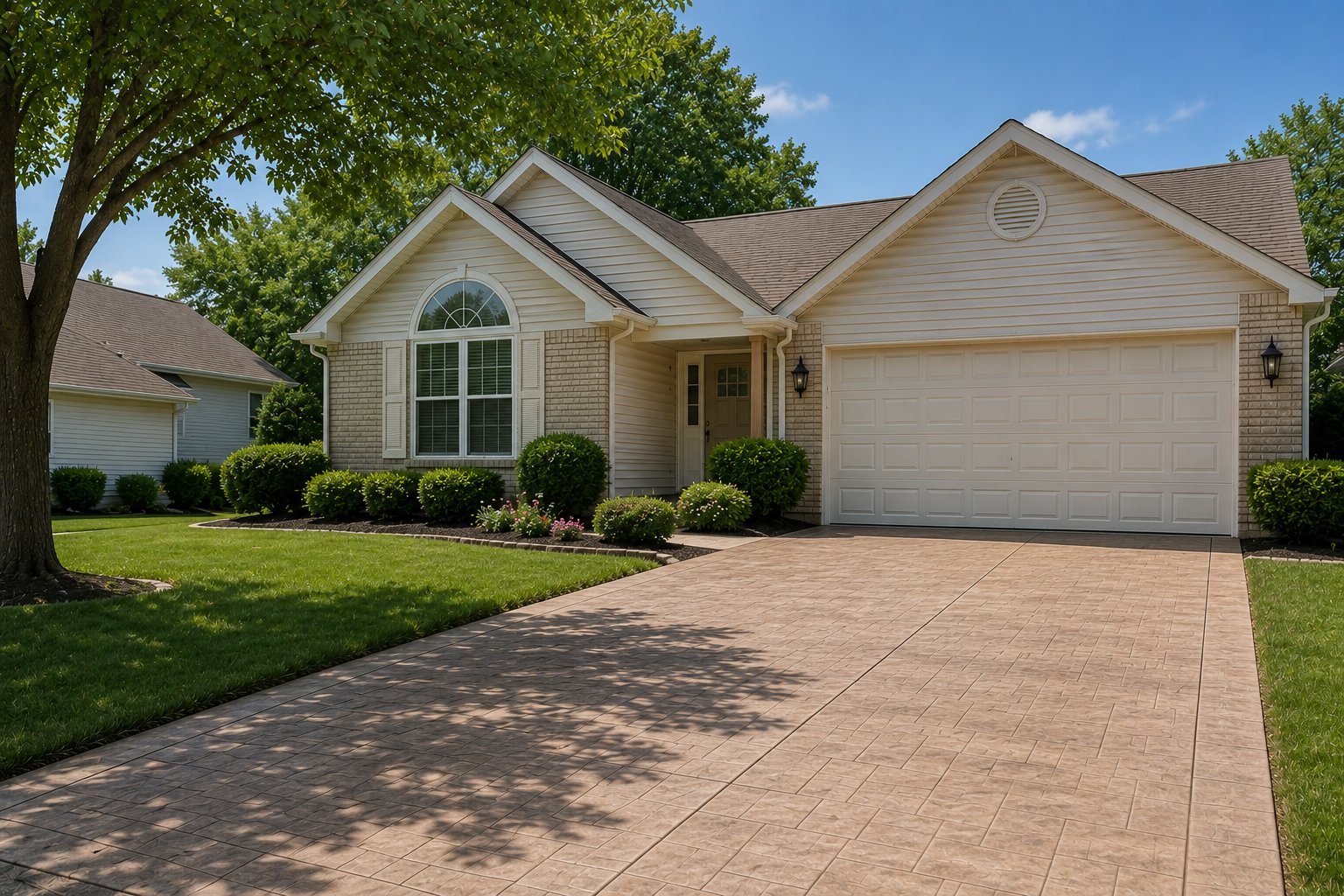
St. Peters has been one of St. Charles County’s most established communities since long before the region’s recent growth. Neighborhoods that took shape along Jungermann Road, McClay Road, and Mexico Road in the 1970s, 1980s, and 1990s are now home to families who have watched their concrete driveways and patios age through decades of Missouri winters and summers. For many St. Peters homeowners, the question isn’t whether to update their concrete—it’s knowing what options are available and what quality installation actually looks like.
Arch City Concrete connects St. Peters homeowners with experienced local concrete professionals who understand the city’s aging housing stock, its demanding clay soil conditions, and the design expectations that come with a community that takes its curb appeal seriously. From Cave Springs to Spencer Creek, from Ohmes Farm to the Mid Rivers corridor, we serve all of St. Peters.
Why St. Peters Homeowners Choose Decorative Concrete
St. Peters is a city with deep roots. Many of its most beloved neighborhoods—the established streets near Willott Road, Suemandy Drive, and St. Peters Centre Boulevard—were built when decorative concrete options were limited. Homeowners got plain broom-finish driveways and simple poured patios because that was what was available.
Today, those same homeowners are discovering that replacement isn’t just a necessity—it’s an opportunity. Modern stamped concrete systems can recreate natural slate, flagstone, cobblestone, and ashlar stone with accuracy that was impossible thirty years ago. Color hardeners and antiquing stains add depth and character. Decorative borders give driveways and patios an architectural finish that dramatically improves curb appeal.
For newer St. Peters developments near the 364/Page Extension corridor and Mid Rivers Mall Drive, homeowners are building outdoor living spaces from scratch—multi-zone patios, fire pit areas, and outdoor kitchens that reflect how families actually use their backyards today.
We serve all of St. Peters including Mid Rivers Mall area, Spencer Creek, Ohmes Farm, Jungermann Road, Mexico Road, Cave Springs, Willott Road, McClay Road, Suemandy Drive, and the 364 corridor, as well as nearby Cottleville, Harvester, St. Charles, and O'Fallon.
Concrete Driveways in St. Peters
A driveway installed in 1985 has now been through nearly four decades of Missouri freeze-thaw cycles. Forty winters of ice, salt, and expansion-contraction stress take a toll even on well-installed slabs. By the time surface spalling becomes visible, random cracking has spread across the field, or the edges begin to crumble, the concrete has often reached the end of its practical life.
Replacement is a significant decision—and an opportunity to make decisions the original homeowner never had. Wider driveways that accommodate two cars side by side. Decorative stamping that coordinates with brick and stone exterior details. Contrasting borders that give the entire entry a finished, custom appearance. These are choices that can transform how your home looks from the street for the next thirty years.
What makes the difference between a driveway that lasts decades and one that begins deteriorating in five or six years almost always comes down to what happens before the pour: how the base is prepared, how the grade is established, and what concrete mix design is specified. For a complete guide to what homeowners should know before replacing a driveway, see: Choosing the Right Concrete Driveway.
Many St. Peters homes built in the 1970s through 1990s have driveways that are now at or past their intended service life. If your driveway shows widespread cracking, significant spalling, or persistent settling near the garage apron, a professional evaluation can help you decide between targeted repairs and full replacement.
Concrete Patio Installation in St. Peters
The backyard patio is where St. Peters families spend their summers. Whether it’s a Friday evening cookout with neighbors from down McClay Road, a graduation party that spills from the back door to the yard, or a quiet Sunday morning with coffee, the patio is where daily life happens outdoors.
A well-designed concrete patio makes that life better. It provides a stable, attractive surface that handles furniture, foot traffic, and weather without complaint. It creates a natural transition between the home’s interior and the yard. And when designed with the right stamping, coloring, and borders, it adds genuine visual value that enhances the home’s overall appeal.
For inspiration on patio layouts, finish options, and design ideas for St. Peters backyards, see: Concrete Patio Ideas: Designing a Backyard You’ll Enjoy for Years to Come.
Stamped Concrete in St. Peters
Stamped concrete has quietly become the most popular decorative surface choice in St. Peters—and for good reason. It provides the richness of natural stone or brick without the cost of real masonry, the individual-unit maintenance of pavers, or the settling issues that come with an unlevel base over time.
Popular stamping patterns throughout St. Peters include ashlar slate, flagstone, and cobblestone for patios; ashlar and large-format stone patterns for driveways; and European fan and herringbone for walkways and entry areas. Color choices that complement the warm beige, tan, and cream tones common in St. Peters architecture—sandstone, buff, charcoal antiquing—help completed projects feel like natural extensions of the home rather than afterthoughts.
For a detailed comparison of stamped concrete versus pavers, covering cost, maintenance, and long-term durability, read: Stamped Concrete vs. Pavers: The Complete Missouri Homeowner’s Guide.
Decorative Borders & Finishes
One of the most impactful upgrades available on any concrete project costs relatively little but transforms the finished look entirely. A decorative border—a contrasting color band, a soldier-course brick pattern, or a textured perimeter frame—gives a driveway or patio a defined, finished edge that dramatically elevates its visual presence.
In St. Peters neighborhoods where homes often share similar architectural styles, the details are what make individual properties stand out. A charcoal border surrounding a sandstone stamped field, or a double-band border treatment on a driveway apron, signals craftsmanship and care that neighbors notice. These details also help tie together exterior elements—coordinating with shutters, trim colors, stone veneers, and landscaping edges for a cohesive overall look.
Walkways & Sidewalks
A concrete walkway connecting the front entry to the driveway, running along the side of the home to a backyard gate, or linking a patio to a garden area completes the outdoor picture in ways that are easy to underestimate until they’re done. Many St. Peters homeowners who replace their driveway wish they had included a connecting walkway in the original project scope—it’s almost always more economical to do both at the same time.
City sidewalk tie-ins, where required, should be coordinated with your contractor early in the planning process. Requirements vary by location within St. Peters, and handling them properly from the start avoids complications later.
Backyard Patio Expansions
Many St. Peters homes from the 1980s and 1990s were built with minimal patio slabs—a basic 10x12 or 12x16 pad that made sense in its era but feels cramped against today’s expectations for outdoor living. Expanding an existing patio is one of the most cost-effective improvements a St. Peters homeowner can make.
Adding square footage to an existing slab—or replacing the original and expanding at the same time—opens the door to dining areas large enough for a full table, conversation zones around a fire pit, covered pergola areas, and outdoor kitchen footprints that weren’t possible on the original footprint. Planning the full vision now, even if some elements are built in phases, ensures that the concrete layout accommodates everything gracefully from the start.
Outdoor Living Spaces
The most ambitious concrete projects in St. Peters today aren’t simple replacements—they’re complete outdoor transformations. Homeowners near Spencer Creek, Ohmes Farm, and along the newer streets off Mid Rivers Mall Drive are investing in outdoor living environments that include:
- Multi-zone stamped patios with distinct dining and lounge areas
- Fire pit seating areas with integrated concrete seat walls
- Outdoor kitchen pads with utility access planning
- Pergola footings and shade structure foundations
- Decorative steps and level changes between yard areas
- Pool surrounds and spa decks with slip-resistant finishes
- Connecting paths and garden walkways
Designing these spaces as a unified system—rather than individual pours planned separately over multiple years—produces the most cohesive result and avoids the visual and practical challenges of mismatched surfaces added over time.
Concrete Replacement in St. Peters
St. Peters’ age as a community means a significant share of existing concrete in the city is approaching or has exceeded its designed service life. Driveways, patio slabs, walkways, and garage aprons installed in the 1970s through 1990s have been through enough Missouri winters that replacement often makes more financial sense than continued repair.
The decision between repair and replacement deserves honest evaluation. Crack routing and sealing can extend the life of a structurally sound slab. Surface resurfacing can improve the appearance of a slab with surface deterioration but intact structure. But when cracking is widespread, settlement is significant, or the existing slab has heaved or shifted, replacement provides a clean foundation for the next thirty years rather than a temporary fix on an aging one.
Missouri Weather & Freeze-Thaw Protection
St. Peters homeowners know Missouri winters. Hard freezes arrive without warning, ice accumulates on surfaces, and the freeze-thaw cycle that begins in November and often continues through March creates conditions that test concrete relentlessly. Every freeze expands moisture within the concrete matrix; every thaw contracts it. Over years and decades, this repetition degrades even good concrete if it wasn’t properly specified and installed.
Freeze-thaw resistance in Missouri concrete comes from a combination of factors: air entrainment in the mix design (which provides microscopic pressure-relief voids), adequate slab thickness, proper curing procedures in cold weather, and regular resealing to prevent moisture intrusion. A 4,000 PSI air-entrained mix is the standard recommendation for St. Peters driveways and exterior slabs. Contractors who propose lower-strength non-air-entrained mixes are cutting corners that will show in five to seven years.
Drainage & Proper Base Preparation
St. Peters, like much of St. Charles County, sits on expansive clay soils. These soils absorb water and expand; they dry out and contract. This movement beneath a concrete slab—seasonal, predictable, and significant—is responsible for more driveway and patio failures than any other single factor. A slab poured directly onto unprepared clay, or on a base that allows water to accumulate beneath it, is fighting a losing battle from day one.
Quality base preparation means excavating to adequate depth, replacing unstable material with compacted granular base, establishing positive drainage so water moves away from the slab edge rather than pooling beneath it, and installing the concrete with appropriate control joints that allow managed movement rather than random cracking. This work is largely invisible once the project is complete—but it’s what determines whether a patio looks the same in twenty years as it did the week it was poured.
In St. Peters’ clay-heavy soils, the difference between a concrete project that lasts thirty years and one that begins settling in five comes down to what happens beneath the slab. Ask every contractor specifically how they handle base preparation and drainage—the answer tells you more than the price does.