St. Charles is unlike any other city in the region. It carries the weight of genuine history—the first state capital of Missouri, a riverfront community built before the Civil War, a Main Street that has drawn visitors for generations. Its oldest neighborhoods have a character that newer St. Charles County suburbs can’t replicate: mature tree canopies arching over established streets, brick homes with covered porches, front walks that lead to actual front doors people use, yards with decades of landscaping that took lifetimes to grow.
Concrete work in St. Charles requires a different kind of attention than in newer subdivisions. The goal isn’t just a functional surface—it’s a surface that respects the scale, material character, and visual language of homes that were built to last. Arch City Concrete connects St. Charles homeowners with experienced local professionals who understand both the technical demands and the design sensibility that this city deserves.
Why St. Charles Homeowners Choose Decorative Concrete
Homeowners in St. Charles face a challenge that most newer communities don’t: how do you improve a property without diminishing what makes it special? A plain gray replacement slab on a home near Frenchtown or Midtown St. Charles can feel jarring—out of place against painted brick, porch columns, and iron railings.
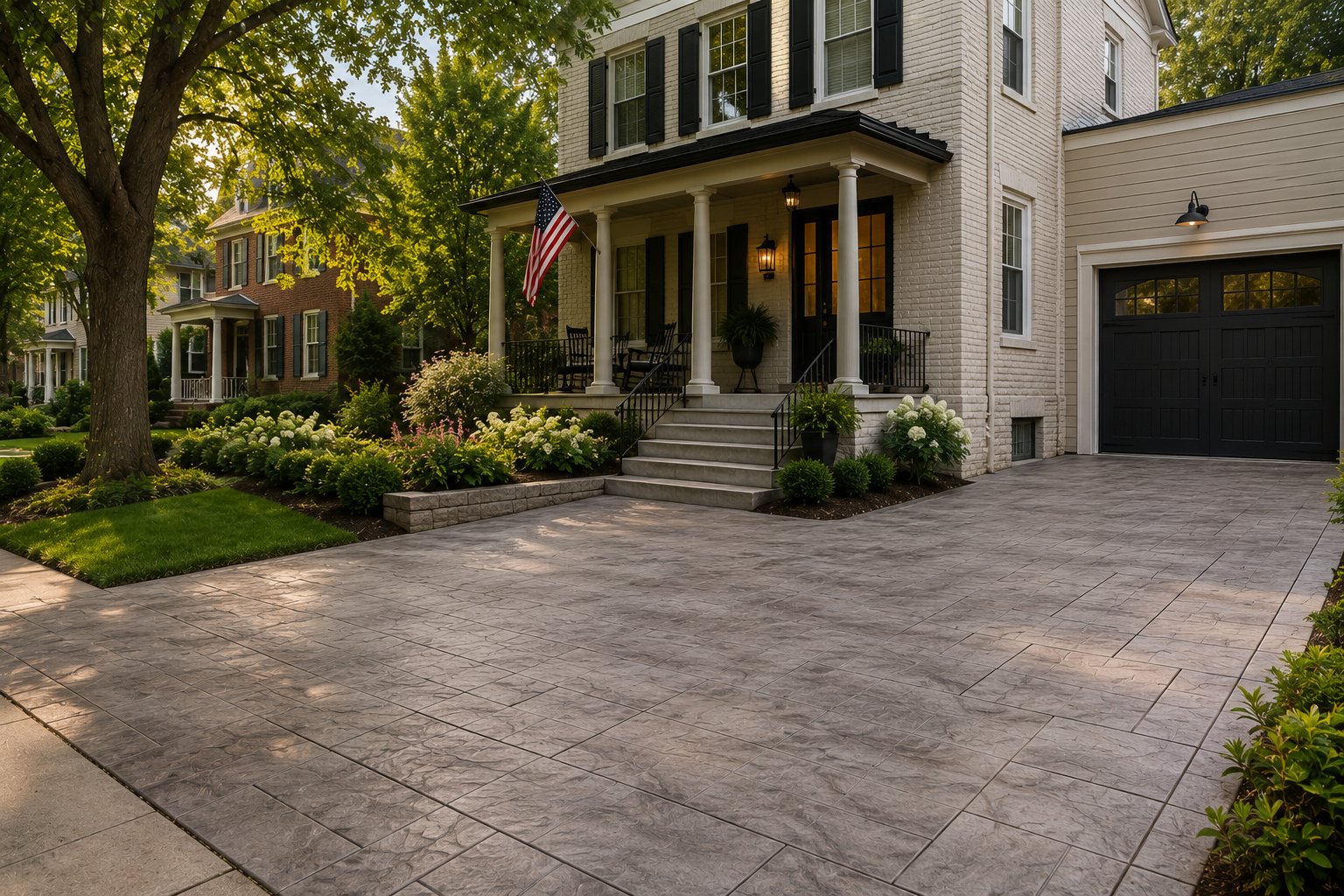
Modern decorative concrete solves this problem. Stamped ashlar slate in charcoal and gray can complement a white brick home the way natural stone would, at a fraction of the cost. Brick-pattern stamping alongside a genuine brick exterior creates a cohesive material story. Textured finishes in warm stone and slate tones coordinate naturally with the earth-toned masonry and wood details that define St. Charles’s architectural heritage.
At the same time, newer developments near Veterans Memorial Parkway, the Family Arena area, and the Page Extension corridor offer a completely different opportunity—fresh construction where homeowners can design outdoor living spaces from scratch without the constraints of working around existing historic character.
We serve all of St. Charles including Historic Main Street, Frenchtown, Midtown, the Lindenwood University area, New Town, Zumbehl Road, Elm Street, Fifth Street, Veterans Memorial Parkway, the Family Arena corridor, and the Page Extension area. We also serve nearby St. Peters, Cottleville, and Harvester.
Concrete Driveways in St. Charles
St. Charles driveways tell the story of the city’s growth in concrete. Homes near Zumbehl Road and the Lindenwood University area often have driveways poured in the 1960s and 1970s—slabs that have now endured sixty years of Missouri winters. Even well-installed concrete of that era is showing its age: random cracking from tree root pressure, spalling from decades of freeze-thaw cycling, settlement at the garage apron, and edges that have crumbled from salt and seasonal stress.
For homes in Midtown St. Charles and the streets near Fifth Street and Elm Street, driveways are often narrower than current standards—built when one-car households were the norm and second vehicles parked on the street. Widening a replacement driveway during installation costs a fraction of what a separate mobilization would cost later, and it immediately improves the daily functionality of the property.
Decorative upgrades on replacement driveways are particularly impactful in St. Charles because they allow the concrete to speak the same material language as the home. A stamped ashlar driveway with a charcoal antiquing wash alongside a white brick home with black shutters creates a composition that feels intentional and elevated. For a homeowner’s guide to everything that goes into a quality driveway project, see: Choosing the Right Concrete Driveway.
Mature trees are a defining feature of St. Charles’s most established neighborhoods—and a significant source of driveway and sidewalk damage. Root barriers, adjusted slab layouts, and deeper base preparation can help manage root interference when replacing concrete near large trees without requiring their removal.
Concrete Patios for Established Homes
Backyard space in St. Charles’s older neighborhoods tends to be more intimate than in newer suburban developments. Lots near Historic Main Street and Frenchtown were platted generations ago, and outdoor spaces often require creative design rather than sheer square footage. A well-planned stamped concrete patio can make a modest backyard feel intentional and complete—a proper outdoor room rather than a leftover space behind the house.
For homes with larger yards near the Lindenwood University area or the streets off Zumbehl Road, patio design can accommodate more ambition: a dining zone beneath a pergola, a fire pit seating area with a low seat wall, an outdoor kitchen pad that prepares for future appliance installation. The stamped concrete surface provides the visual foundation that holds all of these elements together.
For design inspiration and layout ideas, see: Concrete Patio Ideas: Designing a Backyard You’ll Enjoy for Years to Come.
Stamped Concrete and Decorative Finishes
The most frequent concern St. Charles homeowners raise about decorative concrete is whether it will look appropriate alongside older, more traditional homes. The answer depends on selection—and the right selection almost always works beautifully.
Natural stone-inspired patterns work particularly well in St. Charles. Ashlar slate in cool gray and charcoal tones coordinates naturally with painted brick, stone veneers, and white siding. Flagstone patterns in warm sandstone and buff tones complement homes with natural brick and wood details. Brick-inspired stamping used on a side walkway or entry court of a brick home creates a cohesive material conversation rather than visual competition.
Borders are especially important in St. Charles’s context. A contrasting border—slightly darker or lighter than the field pattern—gives a patio or driveway a finished, considered edge that reads as craftsmanship. It’s the kind of detail that distinguishes a decorative concrete project from a simple replacement pour. For a detailed look at decorative surface options, including how stamped concrete compares to pavers in cost and maintenance, read: Stamped Concrete vs. Pavers: The Complete Missouri Homeowner’s Guide.
Walkways, Sidewalks, and Entryways
In St. Charles’s older neighborhoods, the front walk is not an afterthought—it’s an architectural element in its own right. Homes near Historic Main Street and the streets of Midtown St. Charles were built when front doors were actually used, and the path from the sidewalk to the porch was a meaningful sequence. A cracked, sunken front walk doesn’t just look neglected—it undermines the entire character of the home’s presentation.
Replacing a front walk is an opportunity to improve both safety and appearance simultaneously. A stamped or decoratively scored concrete walk that matches the driveway material and border treatment creates a unified entry experience. Porch steps, if original concrete is spalling or settling, can be rebuilt to match the new walk for a cohesive result.
Side-yard paths connecting the front entry to a backyard gate, or a garden path winding through a side yard, are practical additions that improve daily circulation and add a layer of landscape design that feels purposeful. City sidewalk connections and permits, where required, should be coordinated early in the project planning process.
Outdoor Living Spaces
St. Charles homeowners who invest in their outdoor spaces tend to approach them with the same care they bring to their interiors. The goal isn’t just square footage—it’s a space that fits the home’s character while meeting the genuine needs of how the family lives.
In an established neighborhood, that might mean a modestly scaled patio with stamped concrete in a pattern that complements existing exterior brick, a small fire pit seating area with a seat wall that doubles as a planter edge, and a garden path connecting the back door to a detached garage. In a newer St. Charles home near Veterans Memorial Parkway or the Family Arena area, it might mean a full outdoor room with a pergola, built-in kitchen pad, and multi-zone stamped patio designed to accommodate guests from the neighborhood just as comfortably as family dinners at home.
Either way, the concrete surface is the foundation. Getting it right—the pattern, the color, the scale, the border details—is what determines whether the finished outdoor space feels designed or assembled.
Concrete Replacement and Modernization
The most common conversation Arch City Concrete has with St. Charles homeowners begins the same way: the existing concrete is in rough shape, they’ve patched it before, and they want to know whether it makes sense to keep patching or start fresh.
The honest answer depends on what’s actually happening beneath the surface. Crack routing and sealing is the right choice when a structurally sound slab has surface-level cracking that hasn’t compromised the base. Resurfacing can restore the appearance of a flat, stable slab with cosmetic deterioration. But when cracking is widespread and structural, when the slab has heaved or settled significantly, or when tree root damage has undermined the base across a large area, replacement is the only path to a durable result.
In St. Charles, replacement is often also an opportunity for modernization. Driveways built for one car can be widened for two. Plain gray slabs can be replaced with stamped surfaces that elevate the home’s curb appeal. Patios installed in the 1980s with a simple 12x16 slab can become full-featured outdoor rooms. The concrete work that needs to be done is often also the best time to do the concrete work you’ve wanted to do for years.
Why Local Conditions Matter in St. Charles
St. Charles sits at the confluence of the Missouri and Mississippi Rivers. That riverfront character—the thing that makes Historic Main Street and Frenchtown so atmospheric—also means moisture. The river valley creates conditions that can accelerate concrete deterioration: higher average humidity, more frequent freeze events as moist air meets cold fronts, and soils that retain water longer than drier upland areas.
Missouri’s freeze-thaw cycle is hard on concrete everywhere. But in St. Charles’s older neighborhoods, where large deciduous trees create shade that slows ice melting and where drainage in some areas hasn’t been updated since the homes were built, the conditions that degrade concrete are particularly persistent. Air-entrained mix designs, sealed surfaces, and properly graded bases that shed water efficiently are not optional in this environment—they’re the baseline for a project that will perform as expected.
Clay soils throughout St. Charles County expand when wet and contract when dry. This seasonal movement beneath slabs creates the kind of gradual, cumulative stress that produces cracking and settlement over years. Proper base preparation—excavating to adequate depth, installing compacted granular material, and establishing drainage that keeps water moving away from the slab perimeter—is the most important factor in long-term concrete performance. It’s also the work that happens before the concrete truck arrives and is entirely invisible when the project is done.
Before signing a contract for concrete work in St. Charles, ask specifically how the base will be prepared and how drainage will be managed. These questions reveal more about a contractor’s quality than any price estimate or portfolio photo. The invisible work beneath the slab determines whether a project lasts ten years or thirty.