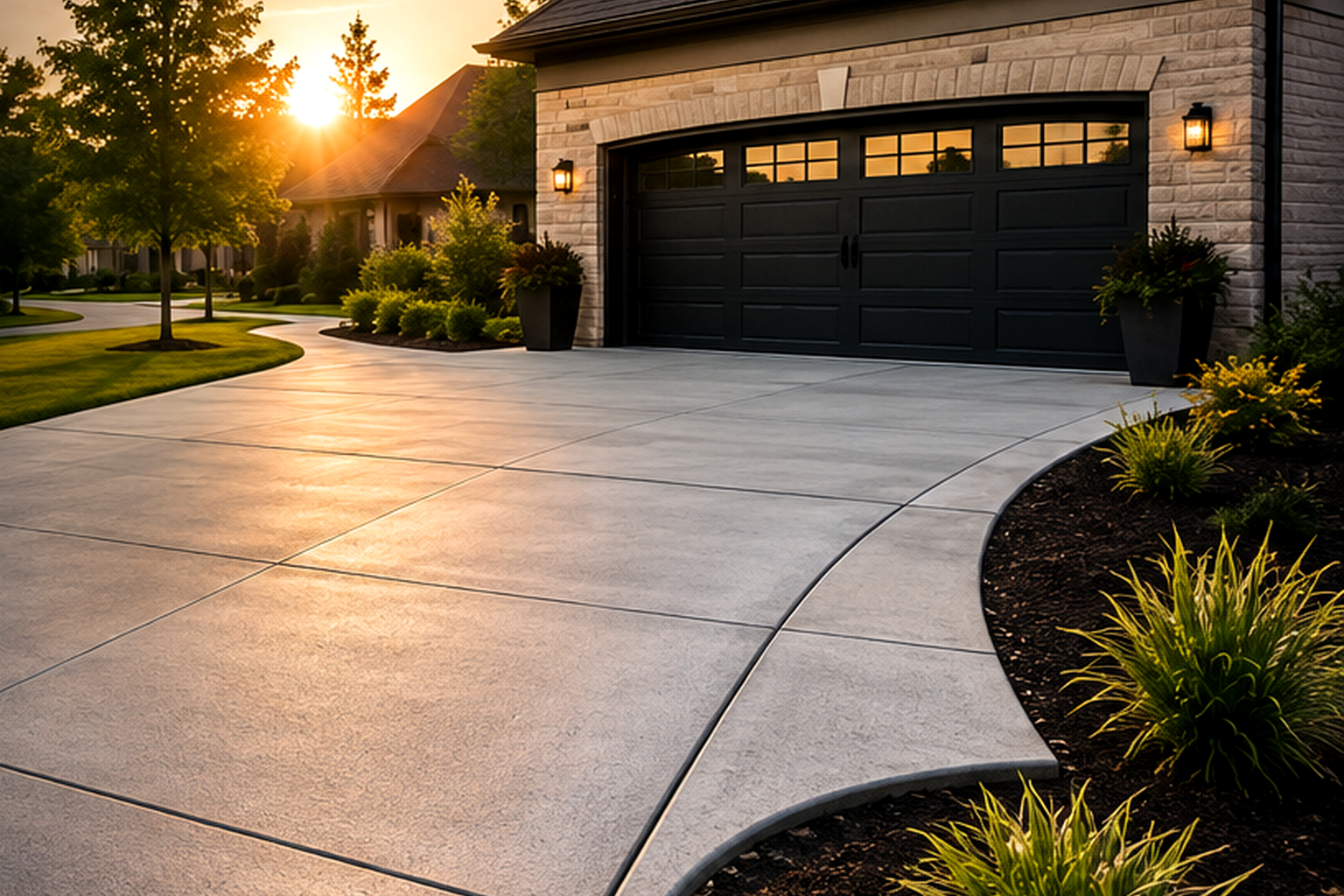
Replacing a concrete driveway isn’t something most homeowners do very often. For many families, it may only happen once while they own their home. That also makes it one of the more difficult home improvement projects to budget. The truth is, there isn’t a single price for a concrete driveway. But once you understand what actually influences the cost, comparing estimates becomes much less overwhelming.
What Has the Biggest Impact on Concrete Driveway Cost?
Every project is unique, but the same handful of factors tend to influence pricing more than anything else.
| Cost Factor | Why It Matters | Impact |
|---|---|---|
| Driveway Size | Larger driveways require more concrete, labor, and finishing time. | High |
| Concrete Thickness | Additional thickness increases material usage and may be recommended for heavier vehicles. | High |
| Excavation & Base Prep | Removing old concrete, rebuilding the base, and correcting drainage often represent a significant portion of the project. | High |
| Reinforcement | Rebar or wire mesh improves structural performance and long-term durability. | Moderate |
| Decorative Finishes | Stamped concrete, borders, exposed aggregate, and color treatments require additional craftsmanship. | Moderate to High |
| Site Accessibility | Limited equipment access or difficult layouts can increase labor requirements. | Moderate |
Very little of the final cost is determined by the concrete itself. Much of the investment comes from creating the conditions that allow the concrete to perform well for decades. A beautiful driveway is only as good as the preparation beneath it.
A Driveway Is Built From the Ground Up
Imagine building a home on an unstable foundation. No matter how attractive the finished home looks, problems will eventually appear if the structure underneath wasn’t properly prepared. Concrete driveways work much the same way.
A newly finished driveway can look flawless on the day construction is complete. But if the soil wasn’t properly compacted, the base wasn’t rebuilt where needed, or drainage problems were ignored, the concrete has little choice but to move as the ground beneath it changes over time.
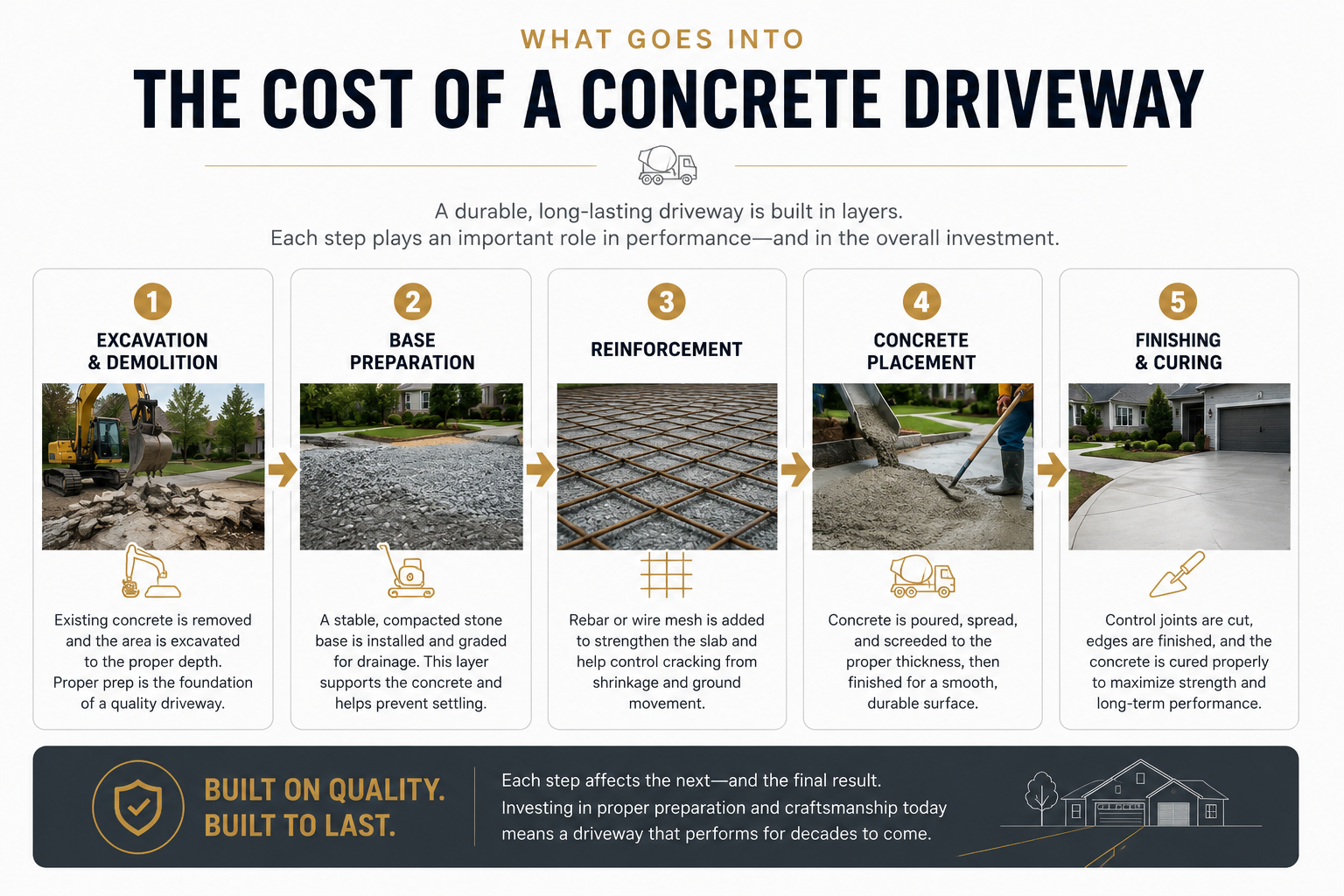
That’s why experienced concrete contractors spend so much time performing work homeowners may never actually see: excavation, compaction, grading, stone base preparation, and drainage corrections. None of these steps are particularly exciting, but they’re often what separates a driveway that lasts for decades from one that begins showing signs of premature settling or deterioration.
When comparing estimates, it’s worth remembering that you’re not simply paying for concrete. You’re investing in everything required to support that concrete for years to come.
A quality concrete driveway is priced from the ground up—not from the top down. The visible concrete may be what catches your eye, but the preparation underneath it is often what determines how well it performs for the next twenty or thirty years.
Why Every Driveway Is Different
It’s easy to assume that if two driveways are roughly the same size, they should cost about the same. In reality, that’s rarely the case.
One property may already have a stable, well-draining base suitable for new concrete. Another may require complete removal of the existing driveway, additional excavation, imported aggregate, grading corrections, or improvements to how water moves across the property.
Accessibility also plays an important role. A wide-open lot allows crews and equipment to work efficiently, while narrow side yards, retaining walls, mature landscaping, or limited truck access can increase the time required to complete the project.
These aren’t details most homeowners notice from the curb, but they’re some of the first things an experienced contractor evaluates during an estimate. That’s one reason reputable contractors are often hesitant to provide exact pricing without seeing the property first—a site visit helps ensure the estimate reflects the actual scope of work, not just the square footage.
Why Square Foot Pricing Doesn’t Tell the Whole Story
One of the most common questions homeowners ask is: “How much does a concrete driveway cost per square foot?” It’s a reasonable question, but it only tells part of the story.
Square footage certainly affects the amount of concrete, reinforcement, labor, and finishing required. But it doesn’t explain why two projects with identical dimensions can receive very different estimates.
Think of square footage as the size of the project—not its complexity. A straightforward replacement on a stable base may require far less preparation than a driveway with drainage concerns, failing subgrade, decorative borders, or extensive demolition. That’s why square-foot pricing is best viewed as a starting point rather than a guaranteed project cost.
Thickness Matters—But Only When It’s Appropriate
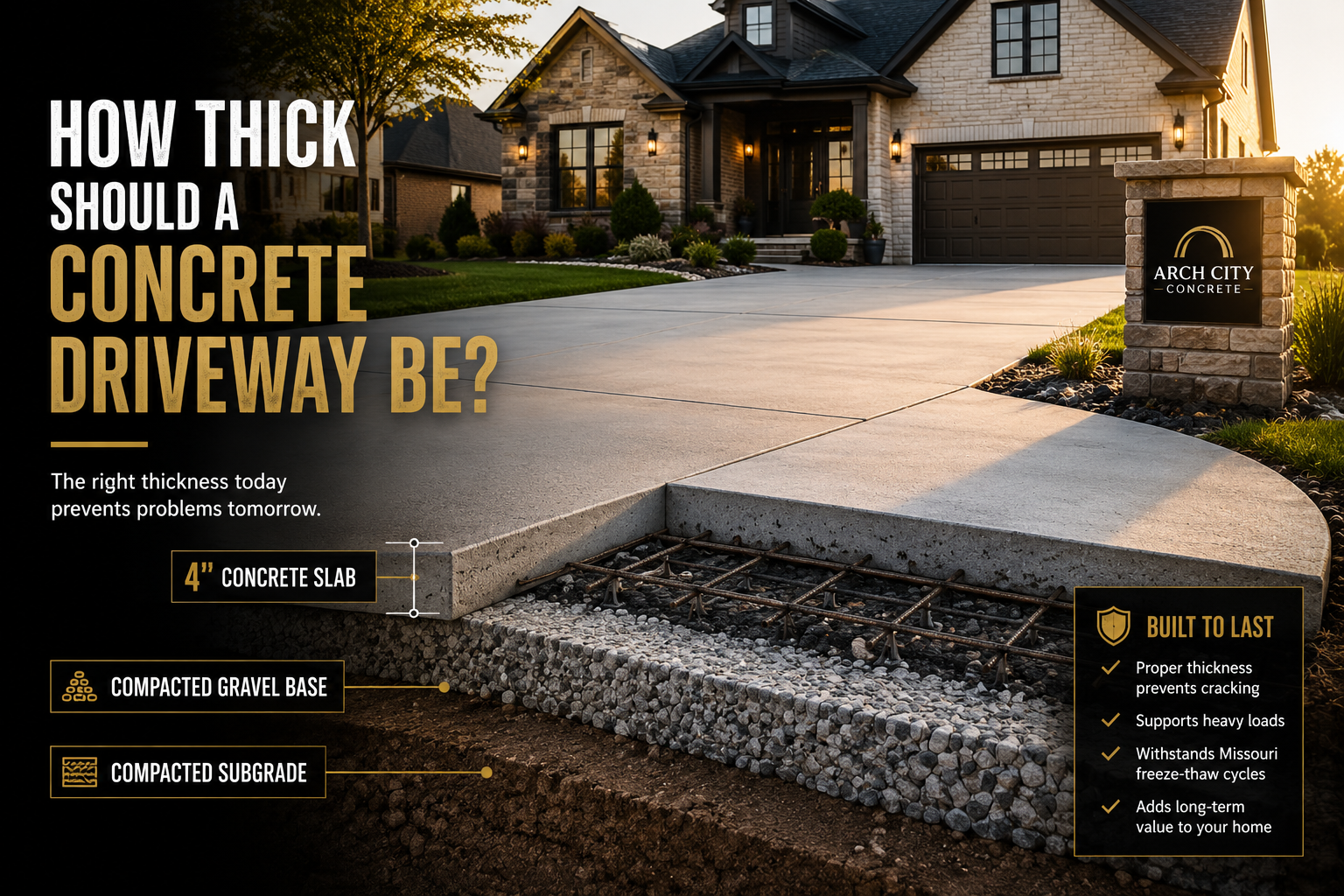
A thicker slab requires more material, but that doesn’t automatically make it the better choice. Instead, the driveway should be designed around how it will actually be used.
A residential driveway used primarily for passenger vehicles has different structural needs than one that regularly supports work trucks, trailers, or recreational vehicles. Choosing the appropriate thickness helps balance durability, performance, and cost without paying for more concrete than the project requires.
For a deeper look at this topic, see our guide on How Thick Should a Concrete Driveway Be?, where we explain how slab thickness affects load capacity, longevity, and long-term performance.
Reinforcement: A Small Part of the Budget, an Important One
Homeowners often ask whether reinforcement is really necessary. While reinforcement usually represents only a small percentage of the overall project cost, it plays an important role in helping concrete perform over time.
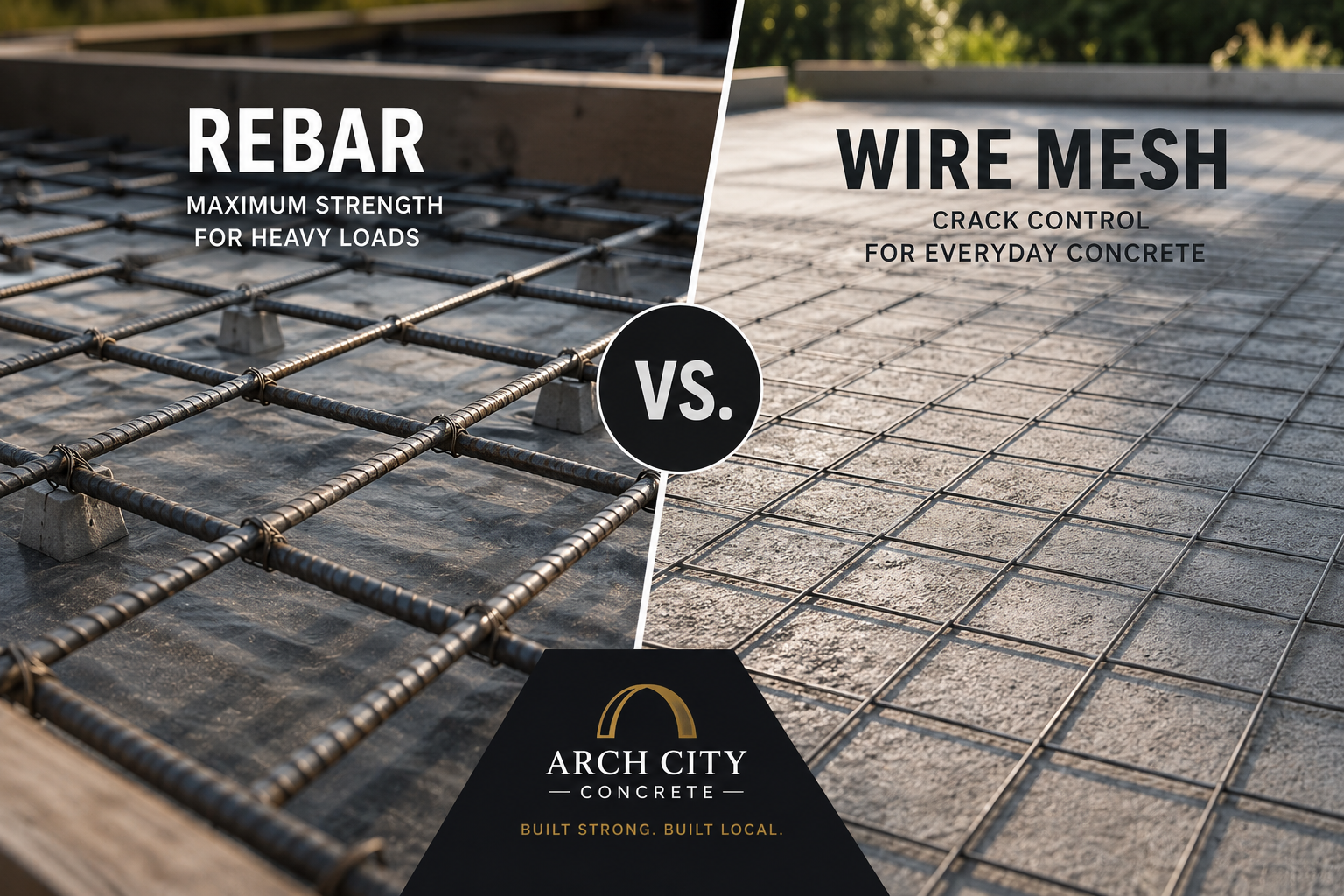
Depending on the design of the driveway, a contractor may recommend steel reinforcing bars (rebar), welded wire mesh, or another reinforcement strategy to help strengthen the slab and better manage the stresses it experiences throughout its lifespan. The best choice depends on the specific project—not simply whichever material costs less.
Our article Rebar vs. Wire Mesh for Concrete takes a closer look at the advantages of each and explains why reinforcement decisions should be made before construction begins.
Looking Beyond the Bottom Line
After requesting a few estimates, many homeowners are surprised to find that the prices aren’t even close. One contractor may provide a proposal that’s thousands of dollars less than another. In many cases, it comes down to what’s included—not just what’s being built.
One estimate may include demolition, disposal of the existing driveway, excavation, a new compacted stone base, reinforcement, careful grading, and cleanup. Another may simply quote the cost of replacing the visible concrete while assuming much of the existing base can remain in place. On paper, both proposals describe a “new concrete driveway.” In reality, they may represent very different scopes of work.
That’s why comparing estimates isn’t simply about finding the lowest number. It’s about understanding what you’re receiving for your investment. If you’re weighing all your options, see our full guide on Choosing the Right Concrete Driveway.
The Lowest Price Isn’t Always the Best Value
Concrete is one of those projects where the least expensive option isn’t always the one that costs the least over time. A driveway built over an unstable base may settle prematurely. Poor drainage can lead to standing water and accelerated wear. Inadequate reinforcement or rushed preparation can create problems that aren’t visible until years after the project has been completed.
None of that means the highest-priced contractor is automatically the best choice. It simply means that price should always be considered alongside preparation, workmanship, materials, communication, and experience. A well-built driveway should provide decades of reliable service.
Planning Ahead Can Save Money
Homeowners sometimes assume the best way to reduce costs is by removing features from the project. In reality, thoughtful planning is often a more effective way to stay within budget.
If you’re already replacing a driveway, it may be more efficient to widen it slightly, improve an adjacent sidewalk, or add a small walkway while crews and equipment are already on site. Likewise, decorative upgrades such as borders, stamped accents, or integrated walkways are usually easier—and often less expensive—to include during the original installation than to add later. Or, if an outdoor patio is in your future, explore our Backyard Patio Ideas guide to start thinking about the full picture.
Questions Worth Asking Every Concrete Contractor
Before comparing estimates, ask each contractor the same questions. Not only will this help you make a more informed decision, but the conversation itself often reveals how thoroughly each contractor approaches the project.
Will the old concrete be completely removed and hauled away, or is the proposal based on leaving portions of the existing structure in place?
Ask how the soil will be evaluated, whether additional aggregate will be installed if needed, and how the base will be compacted before pouring new concrete.
Thickness should be based on how the driveway will actually be used—not simply on minimizing material costs.
Ask whether the proposal includes rebar, wire mesh, fiber reinforcement, or another method, and why that approach is being recommended for your particular project.
Good drainage protects both the driveway and the surrounding property. It’s an important part of the project that’s easy to overlook until problems develop later.
Properly planned control joints help encourage natural concrete movement to occur where it’s intended rather than creating random cracks across the finished surface.
Ask how long the concrete should cure before driving on it, whether sealing is recommended, and what maintenance will help maximize its lifespan.
The cost of a concrete driveway isn’t determined by a single number or a simple price-per-square-foot calculation. It’s shaped by dozens of decisions made before the first yard of concrete is poured—everything from site preparation and drainage to reinforcement, slab thickness, and overall design. The goal isn’t simply to find the cheapest proposal. It’s to understand the value behind it.