
If you’ve ever looked at a newly poured concrete driveway, sidewalk, or patio, you’ve probably noticed a series of straight lines cut into the surface. Many homeowners assume these lines are decorative—or worse, that they’re early cracks forming in the concrete. In reality, they’re one of the most important parts of a properly installed concrete slab.
These intentional grooves are called control joints, and they’re designed to help concrete crack in a predictable location instead of randomly across the surface. For homeowners throughout St. Charles County and the greater St. Louis area, understanding how control joints work can help explain why quality concrete lasts for decades while poorly planned concrete often develops unsightly random cracking.
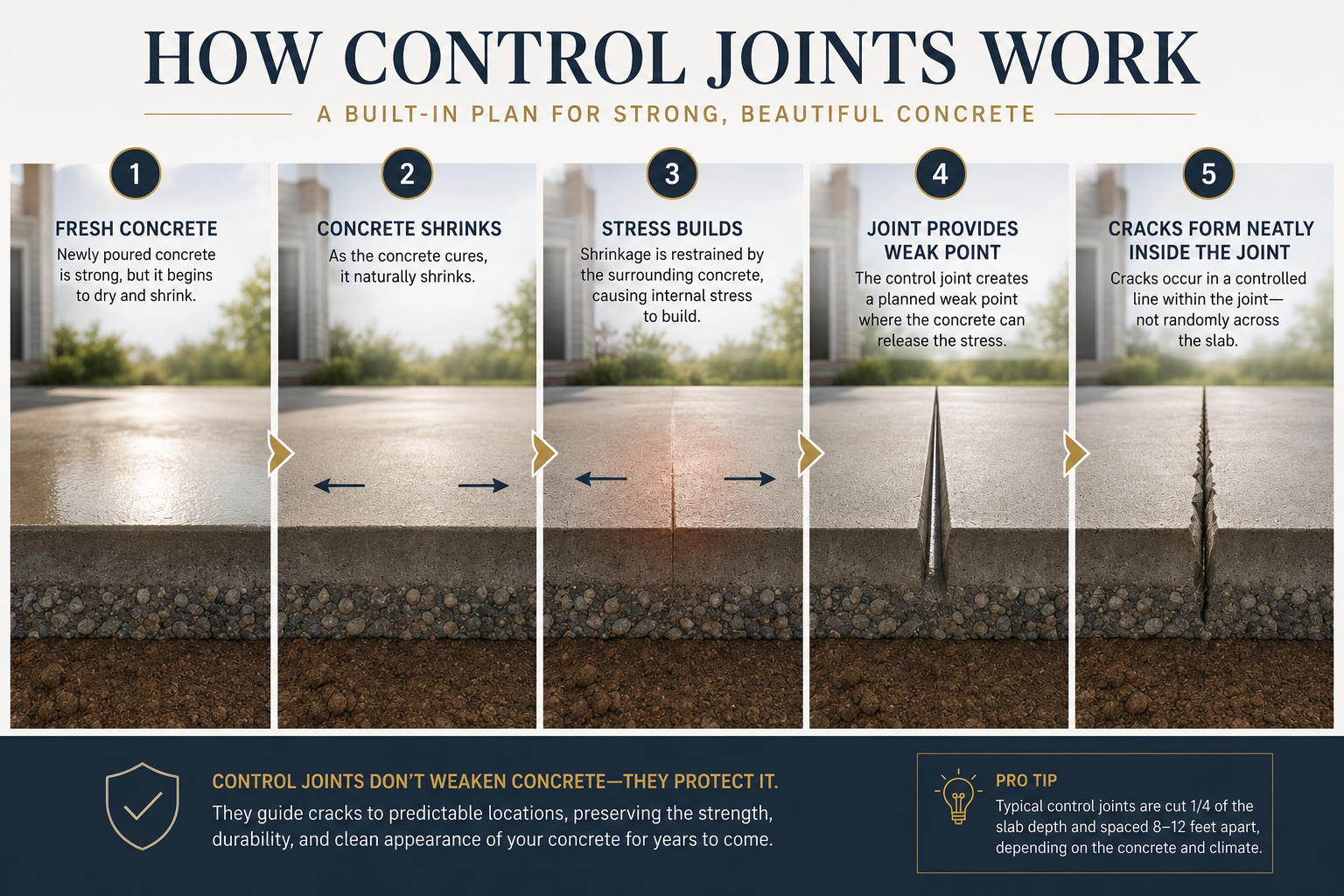
Control joints are intentional grooves cut into concrete to create a planned weak point. As concrete naturally shrinks during curing, stress builds inside the slab. Control joints allow that stress to release in a straight, predictable line instead of creating random cracks across the driveway or patio.
Concrete Is Designed to Crack
That statement surprises many homeowners. Concrete is incredibly strong under compression, but it has one unavoidable characteristic: it shrinks slightly as it cures.
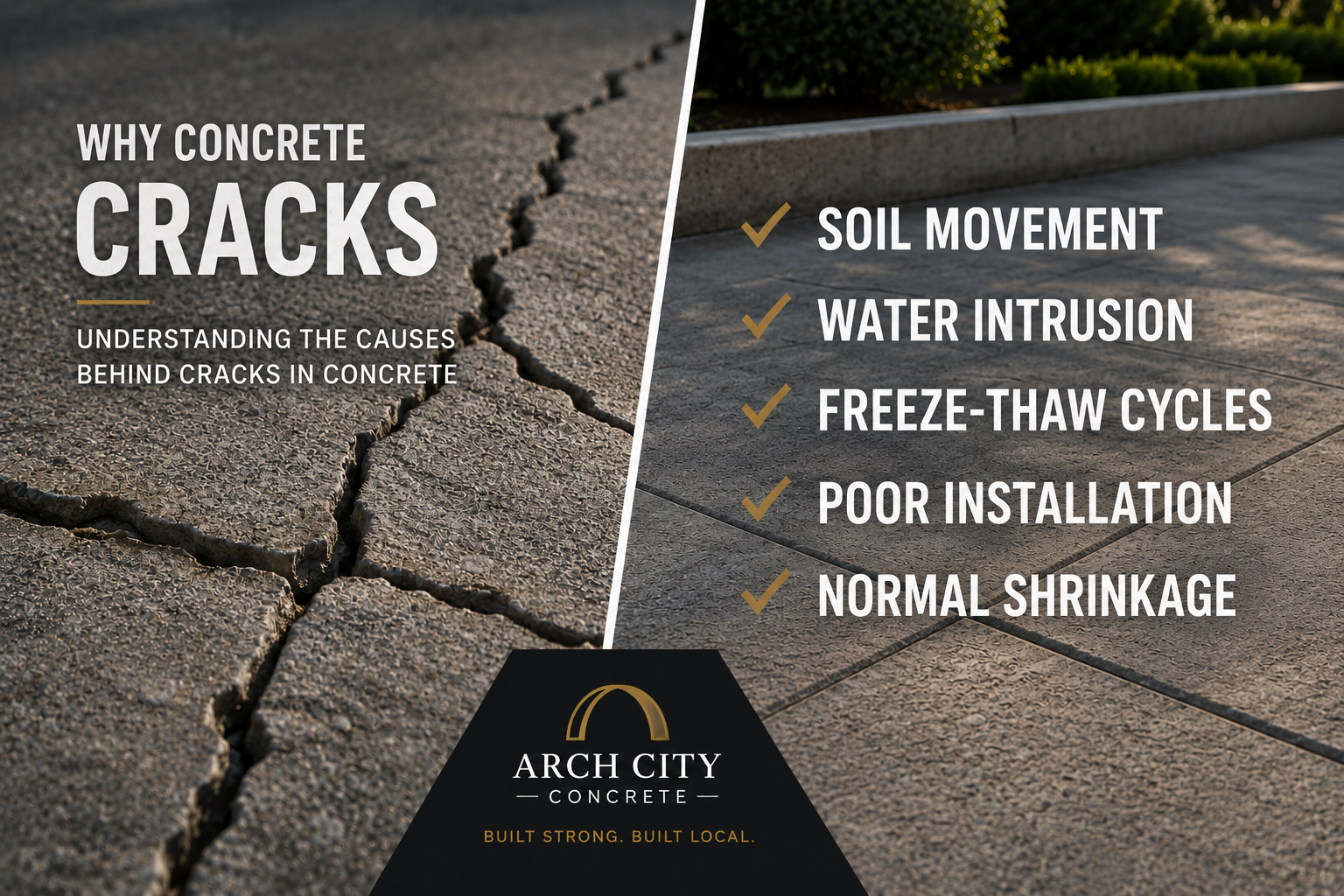
As moisture leaves the concrete during the curing process, tiny internal stresses begin developing throughout the slab. Eventually, something has to give. Without a planned location for that movement, the concrete chooses its own path. That’s what creates random cracks. Control joints simply encourage the concrete to crack where you want it to.
To understand more about why cracks form in the first place, see our companion guide: Why Does Concrete Crack?
Professional concrete contractors don’t install control joints because they expect poor workmanship—they install them because every properly poured concrete slab experiences shrinkage. The goal isn’t preventing cracks. The goal is controlling where they occur.
How Control Joints Work
Imagine bending a thin piece of cardboard. If you lightly score one side first, the cardboard almost always folds along that line. Concrete behaves similarly.
By cutting a shallow groove into the slab, contractors create a controlled weak point. When shrinkage stress develops, the crack forms beneath that groove instead of randomly across the surface. From above, the driveway continues looking clean and intentional.
Why Straight Lines Are Better Than Random Cracks
Without properly spaced control joints, concrete has no guidance. The result is often diagonal cracks, zig-zag cracks, spider-web cracking, and irregular fracture patterns. With correctly installed control joints, cracks stay hidden inside the joint, the slab maintains a cleaner appearance, future repairs are minimized, and the driveway ages more gracefully.
Control joints don’t eliminate movement—they organize it.
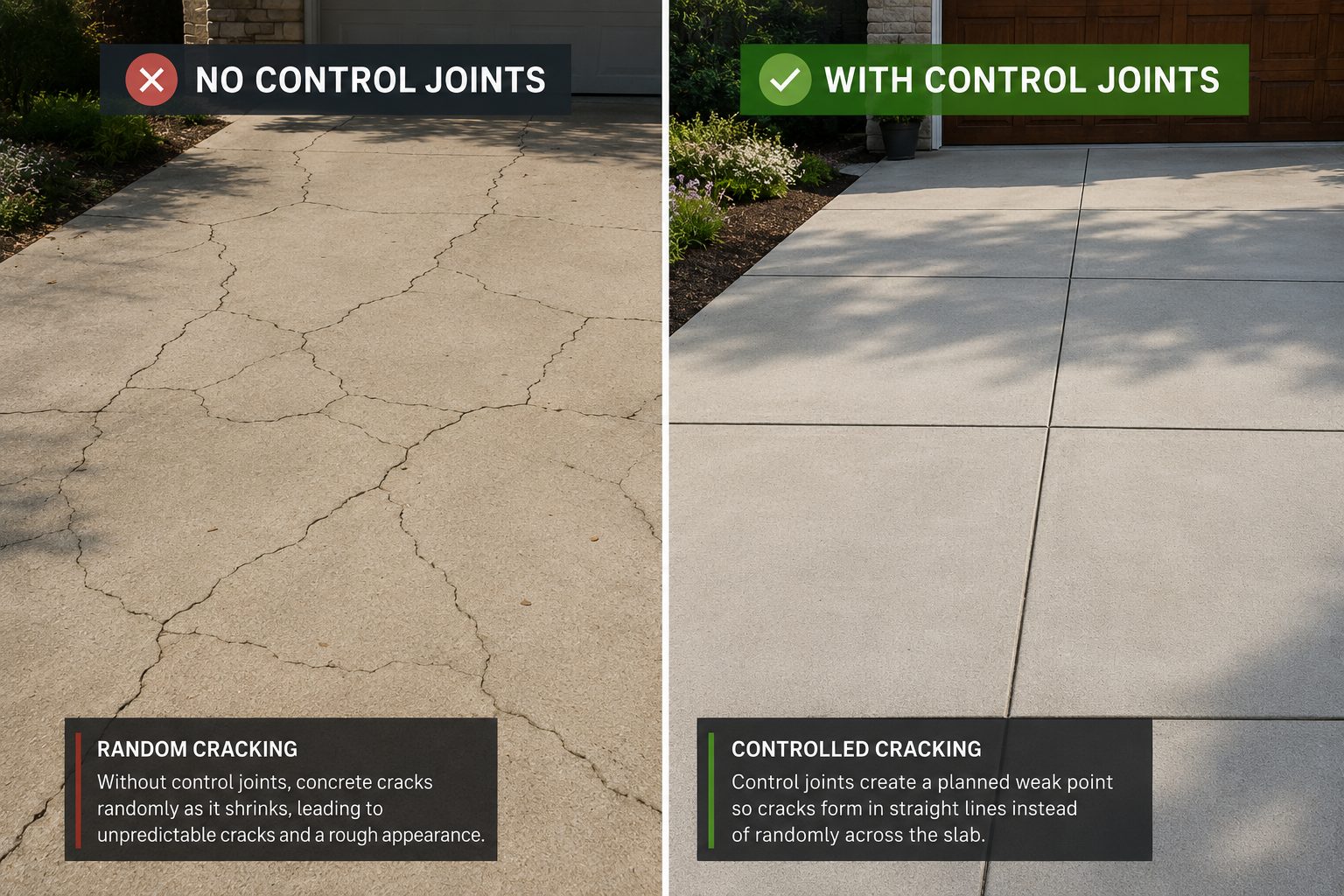
Concrete With vs. Without Control Joints
- Random, unpredictable cracking
- Irregular appearance across the slab
- Harder to repair effectively
- Less professional finish
- Greater chance of visible surface cracking
- Predictable cracking beneath the joint
- Clean, organized layout throughout
- Easier to maintain over time
- Premium, professional appearance
- Cracks remain hidden inside joints
When Are Control Joints Installed?
Timing matters. Most residential concrete contractors create control joints in one of two ways:
Tooled Joints
These are formed while the concrete is still fresh using a specialized grooving tool. They’re common on sidewalks, patios, and decorative concrete. The texture blends naturally with the freshly finished surface.
Saw-Cut Joints
Once the concrete has gained enough strength to support a saw without tearing, contractors cut shallow joints into the surface. This method is commonly used on driveways because it produces crisp, straight lines with a professional appearance. Waiting too long to cut these joints can allow random cracks to develop before the control joints are in place.
How Deep Should Control Joints Be?
A common rule used throughout the concrete industry is that control joints should be cut to approximately one-quarter of the slab’s thickness. For a standard residential driveway poured at 4 inches thick, the joints are typically about 1 inch deep. This provides enough weakness for the concrete to relieve internal stress while preserving the slab’s structural integrity.
If you’re uncertain what thickness is right for your project, see our guide on How Thick Should a Concrete Driveway Be?
Control joints do not weaken concrete—they protect it. By providing a planned location for movement, they help preserve both the appearance and long-term performance of the slab. They’re not a sign of poor workmanship. They’re one of the clearest indicators that a contractor planned for the natural movement of concrete.
How Far Apart Should They Be?
Spacing depends on several factors, including slab thickness, reinforcement, and overall layout. As a general guideline, control joints are often spaced between 8 and 12 feet apart on residential driveways. Contractors also try to create panels that are roughly square rather than long rectangles. Balanced panel sizes reduce internal stress and encourage more predictable cracking.
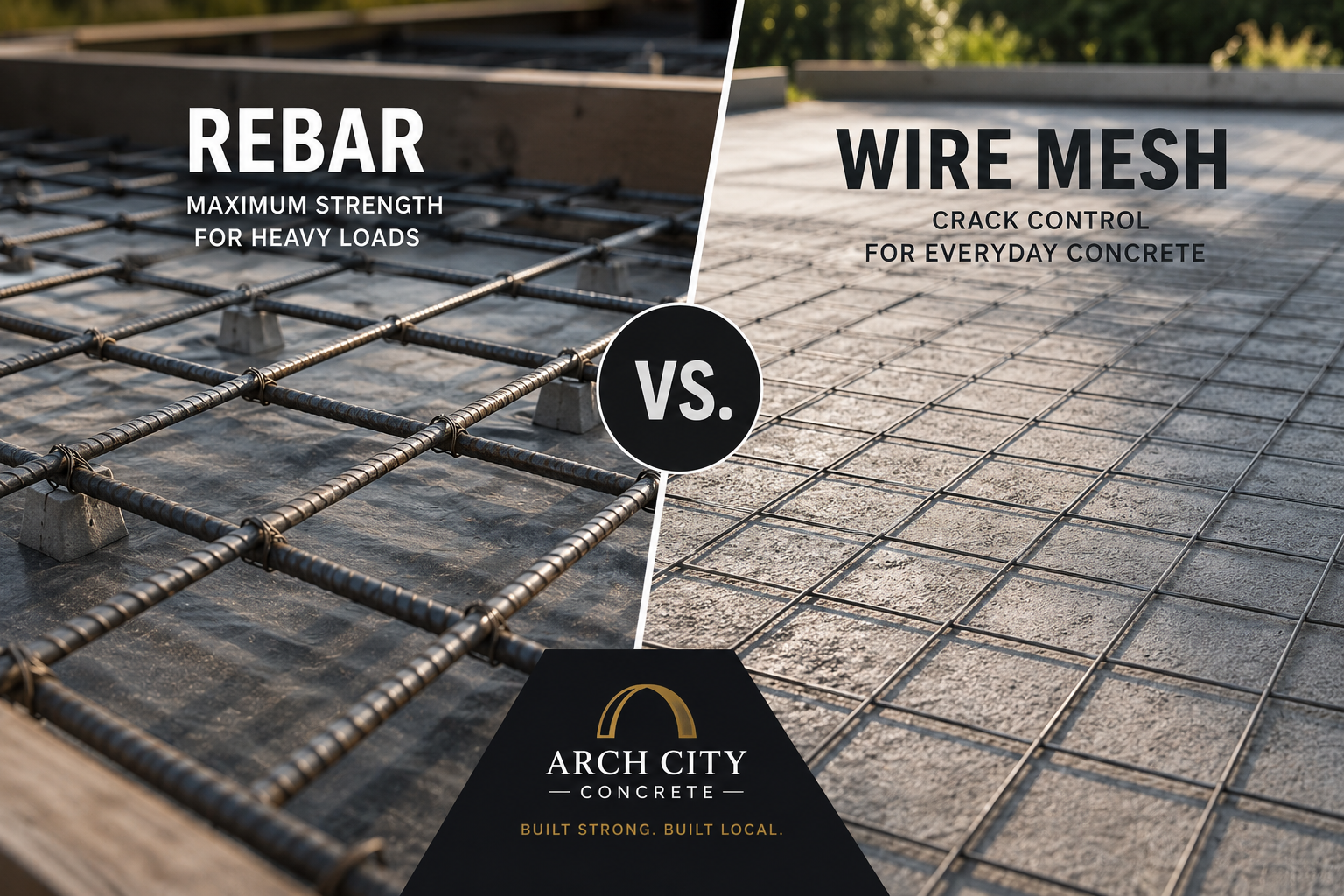
The type of reinforcement used can also influence joint spacing—a well-reinforced slab may have slightly more flexibility in how joints are positioned.
Control Joints vs. Expansion Joints
These two terms are often confused by homeowners and even occasionally misused by contractors, but they serve different purposes and address different problems.
| Feature | Control Joint | Expansion Joint |
|---|---|---|
| Purpose | Guide natural shrinkage cracking to a planned location | Separate two structures and allow independent movement |
| Location | Cut into the slab surface at regular intervals | Placed between slab and another structure (garage, curb, wall) |
| How It Works | Creates a weak point so concrete cracks predictably beneath the groove | Provides a physical gap so slabs can expand and contract independently |
| Material | Tooled groove or saw cut | Flexible material such as foam backer rod or fiber board |
| Typical Use | Throughout the driveway, patio, or sidewalk slab | Between driveway and garage floor, sidewalk and curb |
| Appearance | Thin, precise line cut into the concrete surface | Wider gap, often filled with a compressible material |
Can You Prevent Concrete From Cracking Completely?
Unfortunately, no. Even the highest-quality concrete installed by experienced professionals will develop internal stresses during curing. Proper reinforcement, base preparation, drainage, and control joints all work together to produce a driveway that performs well over time.
The difference is whether those inevitable cracks appear in organized, planned locations—or randomly across the slab. A well-built driveway in St. Charles County should look as clean and intentional at year twenty as it did the day the crew packed up and left. Understanding how long that lifespan should realistically be is worth exploring in our guide: How Long Does a Concrete Driveway Last?
And if a driveway is already showing signs of deterioration beyond what control joints can address, see our guide on Should You Repair or Replace Your Concrete?
Those straight lines in your driveway aren’t flaws. They’re one of the clearest signs that the concrete was installed with long-term performance in mind.
Control joints help guide natural shrinkage, reduce unsightly random cracking, and keep your concrete looking cleaner for decades. Understanding their purpose also makes it easier to recognize the difference between expected concrete behavior and problems that may require professional attention.
If you’re planning a new driveway and want to understand all the factors that contribute to long-term performance, see our guide to Choosing the Right Concrete Driveway.